Leadership Minor
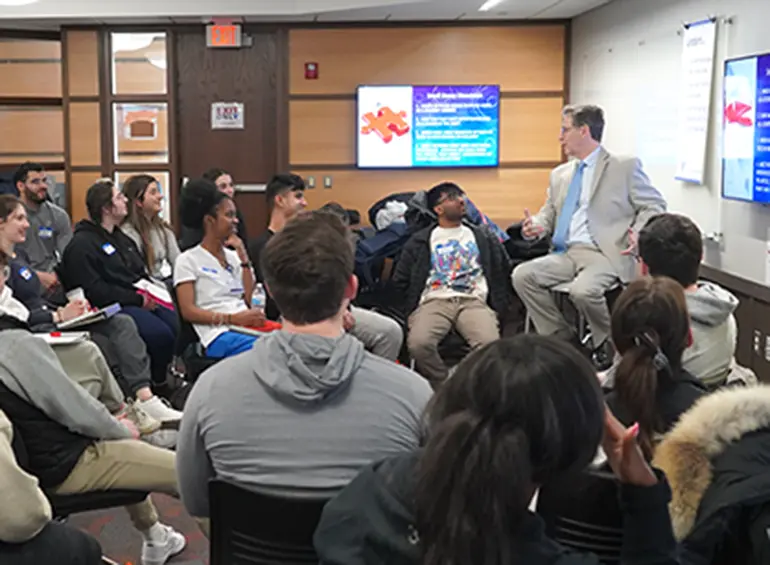
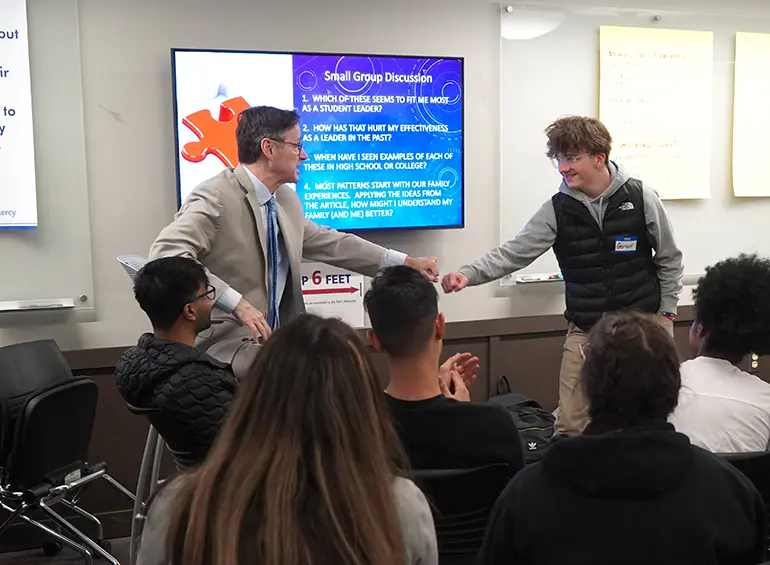
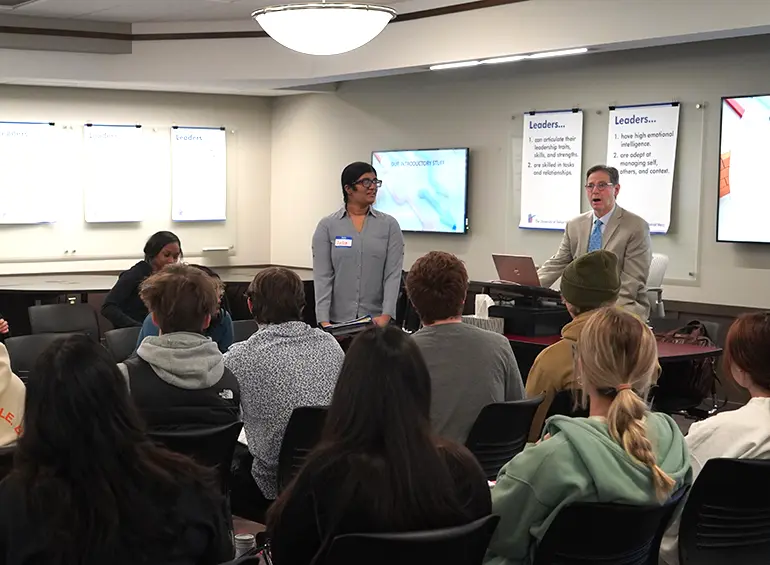
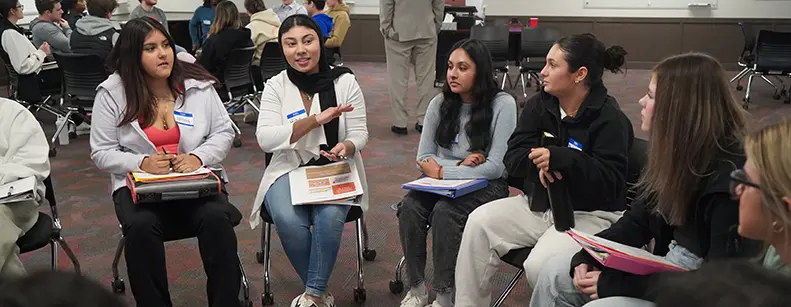
With more than 700 students, the Leadership Minor is by far the most chosen minor on campus!
First: LEAD 2000 - Exploring Leadership (3 credits)
- Students are required to complete the Leadership Minor Pre-Assessment during the Introductory Course
Then: (One course from approved list in each area below):
- Individual Leadership Skills
- Group Skills
- Organizational Management & HR Skills
- Community Engagement Skills
Final Class: LEAD 4000 or PYC 4620 - Leadership Capstone (3 credits)
Final Step: Students are required to complete the Leadership Minor Post-Assessment before their minor is certified and granted. Notifications will be sent out when students apply to graduate.
Requirements for the Leadership Minor (18 credits)
This information is from the current Undergraduate Academic Catalog
Please note: Although a course may appear in more than one category, a course can only be used once to satisfy the requirements of the minor. Always follow the Leadership Minor sheet found on the University website.
Students are encouraged to take the introductory course as soon as possible in their academic career.
Requirements
- First LEAD 2000 Introduction to Leadership (3 credits)
- Then one course from approved list in each area below:
- Individual Leadership Skills (3 credits)
- Group Skills (3 credits)
- Organizational Management and Human Relations Skills (3 credits)
- Community Engagement Skills (3 credits)
- Final LEAD 4000 Leadership Capstone (3 credits) OR PYC 4620 Leadership Capstone (3 credits)
- Three of the six courses used for the minor must be at 3000 or above.
1. Individual Leadership Skills
- Self-awareness
- Character and integrity
- Ethics and values
- ENGR 1000* Engineering Ethics (2 credits)
- ETH 3580* Health Care Ethics (3 credits)
- PHL 2010* Foundations of Ethics (3 credits)
*Courses that may satisfy core University objectives
2. Group Skills
- Communication
- Team building
- Developing relationships
- AENG 4100 Architectural Engineering Integrative Design (3 credits)
- CIVE 4820 Civil Engineering Senior Design Project (3 credits)
- CSSE 4951 Senior Design Project I (3 credits)
- ELEE 4011 Electrical and Computer Engineering Department Senior Capstone Design I (2 credits) AND ELEE 4012 Electrical and Computer Engineering Department Senior Capstone Design I Laboratory (1 credit)
- ENL 2750* Diverse Voices in Literature (3 credits)
- GEO 2110 World Regional Geography (3 credits)
- HUS 4410* Multicultural Understanding (3 credits)
- MENG 4950 Prototype Design II (3 credits)
- PAS 1010 Introduction to the Physician Assistant Profession (2 credits)
- PYC 2600* Social Psychology (3 credits)
- PYC 2650* Psychology of Environment (3 credits)
- PYC 4400* Cross-Cultural Socialization (3 credits)
- PYC 4890 Group Dynamics (3 credits)
- SOC 1000* Introduction to Sociology (3 credits)
- TRE 1500* Fundamentals of Human Expression (3 credits)
*Courses that may satisfy University Core Curriculum objectives
3. Organizational Management and Human Relations Skills
- Organizational management
- Project management
- Human relations
- Public relations
- AAS 3100* Science, Technology and Race (3 credits)
- ADS 4360 Family-Based Approaches (3 credits)
- ADS 4440 Advanced Internship (3 credits)
- ARCH 3000 Professional Experience Preparation (1 credit)
- BUS 3110 Organizational Design and Structure (3 credits)
- BUS 3180 Leadership and Teams with Diverse Peoples (3 credits)
- CIS 4505 Software Project Management (3 credits)
- CJS 3950 Criminal Investigation (3 credits)
- CJS 4540 Sociology of Deviant Behavior (3 credits)
- CST 2040 Interpersonal Communication (3 credits)
- CST 3040 Small Group Communication (3 credits)
- CST 3140* Intercultural Communication (3 credits)
- DHY 8200 Concepts in Professionalism (3 credits)
- ENGR 1080 Fundamentals of Engineering Design (2 credits)
- ENGR 3110* Professional Practice of Engineering (2 credits)
- ENL 2750* Diverse Voices in Literature (3 credits)
- HOM 3585 Health Organization Management (3 credits)
- HUS 4410* Multicultural Understanding (3 credits)
- NUR 4650 Nursing Leadership Immersion (3 credits)
- PYC 3700* Industrial and Organizational Psychology (3 credits)
- PYC 4400* Cross-Cultural Socialization (3 credits)
- SCIE 2300 Pre-Healthcare and Science Career Portfolio (1 credit)
- SCIE 4120* Occupational Health (3 credits)
- SWK 3200 Human Behavior: Multicultural Environment I (3 credits)
- TRE 3060 Principles of Arts Management (3 credits)
- WGS 2000* Gender, Sex, and Justice (3 credits)
*Courses that may satisfy University Core Curriculum objectives
4. Community Engagement Skills
- Social change
- Social justice
- Partnerships for the common good
- Mission and vision in broad context
- AAS 2000* Critical Perspectives in African-American Studies (3 credits)
- AAS 3100* Science, Technology and Race (3 credits)
- ADS 4170 Substance Use and Youth (3 credits)
- ADS 4500 Assessment, Referral and Treatment (3 credits)
- ARCH 3100 Public Interest Design Studio (5 credits)
- BUS 3190 Ethics, Business Leadership, and Social Responsibility (3 credits)
- CHM 4900* Recent Advances in Chemistry and Biochemistry (3 credits)
- CIS 4650 Information and Society (3 credits)
- CJS 4510 Criminology and Penology (1 credit)
- CJS 4990 Violence in the Workplace (3 credits)
- COM 8210 Concepts in Community Health (1 credits)
- CST 4990 Capstone Seminar: Media Social Responsibility (3 credits)
- CTA 3010 Engineering Co-op I
- DHY 8240 Ethical and Legal Issues II (2 credits)
- HOM 3300* Health in the Community (3 credits)
- HOM 4610 Health Economics (3 credits)
- HUS 4410* Multicultural Understanding (3 credits)
- NUR 4755* Professional Practice from a Mercy and Jesuit Perspective (3 credits)
- PHL 3560* Peace and Social Justice (3 credits)
- RELS 3400* Class, Race and Gender (3 credits)
- RELS 4140* Gender and Religion (3 credits)
- SOC 2100* Cultural Anthropology (3 credits)
- SWK 2100* Social Welfare and Social Justice (3 credits)
- SWK 3100 Social Welfare Policy (3 credits)
- TRE 2700 Theatre for Social Change (3 credits)
- WGS 2000* Gender, Sex, and Justice (3 credits)
*Courses that may satisfy University Core Curriculum objectives
Final Course
Students must complete the Leadership Minor Pre-Assessment during LEAD 2000: Introduction to Leadership, and the Leadership Minor Post-Assessment before the minor can be certified for graduation. Students receive a notification to complete the Post-Assessment once they submit their graduation application.
The Social Change Model of Leadership
Adapted from the HERI Social Change Model of Leadership Development (1996), this model serves as the theoretical framework for the Leadership Minor and Leadership Academy at the University of Detroit Mercy. It focuses on developing leadership skills and competencies at three interconnected levels: individual, group and community.
Individual Leadership Skills and Competencies
- Self-Awareness and Reflection
- Personal Development and Growth
- One's Character, Values and Integrity
- Developing Emotional Intelligence
- Compassion for Others
- Personal Responsibility and Accountability
- Exploring Your Mission, Vision and Vocation
Group Leadership Skills and Competencies
- Developing Trust and Relationships
- Building Strong Teams with Purpose
- Effective Interpersonal Interactions
- Productive Communication
- Successful Facilitation
- Managing Conflict
- Dealing with Dysfunction
- Leading People Who Aren't Like Me
- Strategic Planning
Community Leadership Skills and Competencies
- Service to the Greater Good
- Making the World Better through Social Justice and Social Change
- Engagement and Respect for Diverse Communities
- Knowing My Civic Responsibilities
- Engaging the Community in Meaningful Ways
The Seven C's of Leadership
The Social Change Model identifies seven core leadership values:
- Consciousness of Self
- Congruence
- Commitment
- Collaboration
- Common Purpose
- Controversy with Civility
- Citizenship
Change is the central goal that connects these values.
Source: Komives, S. R., and Wagner, W. (Eds.). (2017). Leadership for a Better World: Understanding the Social Change Model of Leadership Development. John Wiley & Sons.
Adapted for University of Detroit Mercy. DiPaolo, D. (2026).
- Students will learn how to be authentic leaders with full integrity.
- Students will become more self-reflective and more self-aware.
- Students will clarify their own values, beliefs, and attitudes as they formulate a leadership identity.
- Students will participate in the creation of a healthy classroom culture—one where all student leaders can feel comfortable to learn, reflect, and grow. Students will monitor the expectations that they create to ensure this culture and help hold each other accountable to those expectations.
- Students will be introduced to basic notions and theories about leadership and will gain new insights into what it means to be a leader.
- Students will have a deep understanding of the Social Change Model of Leadership that serves as our frame for all things leadership at UDM.
- Students will become more emotionally intelligent leaders.
- Students will explore their personal mission, vision, and purpose in this world.
- Students will examine their search for meaning, spirituality, vocation, and faith and reflect on how this impacts their life as a leader.
- Students will more deeply connect with the Mission and Vision of UDM and understand how our Ignatian and Mercy traditions, or their own personal faith traditions, call us to step out into the world as servant leaders.
- Students will recognize the value of every person, the human community, and how spiritual beliefs can shape their leadership identity and vocation in life.
- Students will explore and understand contemporary theories about leadership.
- Students will understand the evolution of ideas about leadership and where research in the field currently stands.
- Students will become better leaders and followers in the groups, teams, and organizations to which they already belong.
- Students will understand the role of early family experiences and how these impact leadership styles and practices.
- Students will discover their leadership style and appreciate those of others.
- Students will know and understand conflict styles and how and when to use each.
- Students will be able to identify destructive and toxic leadership, how it happens, and how it can be prevented.
- Students will understand dysfunctions of teams and learn strategies to fix them.
- Students will be able to recognize toxic triangles and how to manage them.
- Students will know and practice the skills of having difficult conversations—critical in holding self and others accountable.
- Students will gain experience in campus community service through participation in a variety of volunteer activities--working with the Office of Student Life, Alumni Relations, TENN, Fr. Tim Hipskind, and others.
- Students will learn to lead people who aren’t like them.
- Students will explore how differences in race, gender, religion, sexual orientation, gender identity, socioeconomic status, ableness, family background, and culture impact leadership.
- Students will be able to articulate how becoming a better leader can improve society as a whole exploring how they can use their increased leadership capacity to create communities that are more fair and just.
- Students will create leadership ePortfolios that will serve as personal resources for years to come.
- Students will complete a Capstone project or experience that allows them to pull together their leadership journey in a way that engaged and improves their community.
For more information, please contact
 Donald DiPaolo, Ph.D.
Director of the Leadership Minor
Room 237, Briggs Building
313-993-1470
dipaoldo@udmercy.edu
Advising Sheets for Majors (beginning Fall '26)