
RPM bridges gaps connecting students and mobility companies
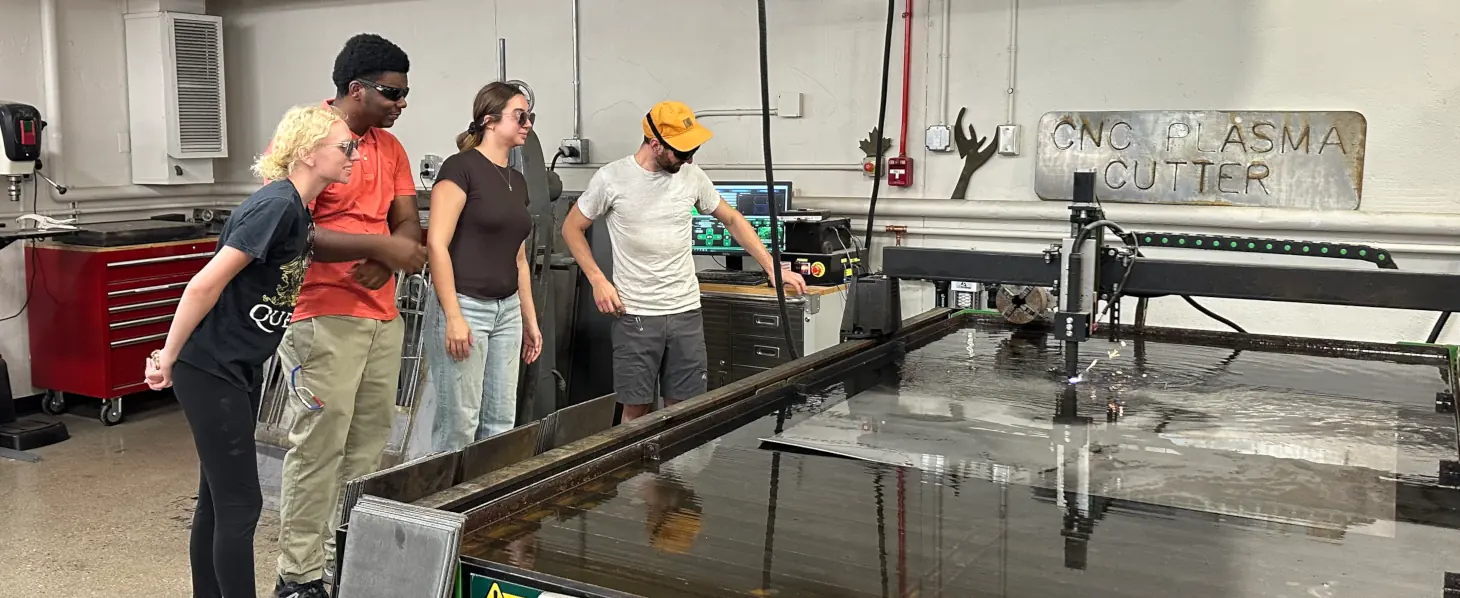
Mechanical Engineering student Nicole Truskolawski entered the spring semester worried she wouldn’t be able to find an internship. She had applied for several positions and interviewed for some but had not found the right opportunity.
At the same time, the small, Royal Oak-based Bonal Technologies, whose technology supports mobility clients, was seeking company funding for research and development, sales efficiency and technical documentation.
Neither knew it at the time, but they were looking for the same thing: an opportunity to turn a need into meaningful work.
By the end of the summer, Truskolawski and two other University of Detroit Mercy students were working at Bonal, where they tackled projects that had a direct impact on the company.
The connection came through the Readying Professionals in Mobility (RPM) program in UDM’s College of Engineering & Science (CES).
Supported by a 2025 grant from the Detroit Regional Chamber Foundation and MichAuto, RPM was created to strengthen Michigan’s future mobility workforce by connecting students with smaller mobility-related companies and helping those companies create and manage meaningful internship experiences.
For smaller companies, creating an internship program can be a challenge of its own.
“These small companies don’t necessarily have the time or expertise to hire interns, onboard them and manage an intern program, so, if we can provide that service, maybe it gets them over the hump,” said Richard Hill, CES associate dean for Research and External Initiatives.
At the same time, students need opportunities to gain experience, particularly in a competitive internship market.
“Small businesses are so lean that if they’re bringing in an intern, the intern needs to actually do some work,” Hill said. “And students are having a hard time getting internships in this market, so we are able to help them get an internship that they weren’t otherwise able to get on their own.”
RPM is designed to meet both needs by finding the right fit between students and companies.
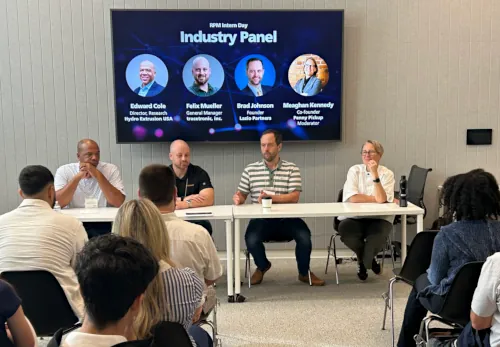 CES Industry Liaison Emily Fleury manages the program alongside Hill. Recently hired to help grow RPM, Fleury said building the program has required reaching out directly to companies, students and other community partners.
“We’ve built this program from the ground up, so we are happy with results so far,” Fleury said.
That work has included cold calling, online job postings, using state resources for small businesses and hosting networking events. The program also connects with potential partners through events such as UDM’s EPIIC Industry & Academia Summit, which brought together more than 150 technology leaders, faculty and innovators to campus in February to network and explore research partnerships.
During its first summer, RPM placed 16 interns with 13 companies, exceeding its initial goal. Two interns have also transitioned to full-time employees, while several others are continuing in a part-time capacity as they complete their studies.
“Most of the companies had not had an intern or an established internship program, so we’re really helping them,” Fleury said.
Although RPM was created and is managed by UDM, the opportunities are open to students from other universities who are seeking internships in the mobility industry.
“There is a very high hit rate since we do the vetting between the students’ skills and the company needs,” Hill said.
One of those successful matches was Truskolawski and Bonal Technologies.
Bonal had been seeking an industrial grant to support several business needs. But the company was able to move forward without the grant and instead use RPM to address some of those needs.
The internships required the students to navigate new problems and uncertainty — exactly the kind of experience that can be difficult to replicate in a classroom.
Bonal regional sales manager Betty Jean Hebel said all three interns proved to be a good fit for the company. “The things they learned in the classroom just cut the time involved by so much,” she said. “But if they did not know something, they would try to get the answer themselves before they use all their resources, which is fabulous.”
One of the projects was designing a portable prototype of Bonal’s Meta-Lax console. Truskolawski worked on the project with Kristina Fedoriv, a junior Mechanical Engineering student, and Kenyae Demps, a senior Electrical Engineering student.
The goal was to address a logistical problem faced by Bonal’s sales representatives, who previously had to pre-ship full-sized consoles by truck when demonstrating the technology to potential customers.
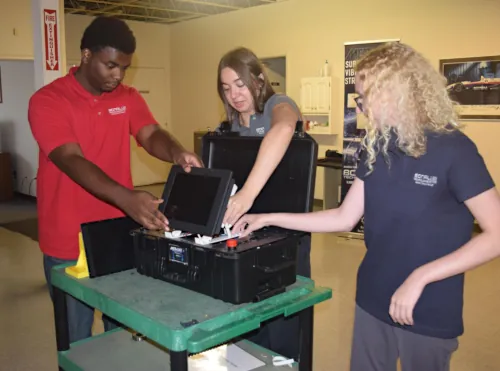 The students followed the project through multiple stages, from computer-aided design (CAD) to fabrication, including cutting metal pieces in UDM’s Steve & Kathy McShane Makerspace & Collaboratory to fit the prototype inside a small carrying case.
But moving a project from a computer screen to the physical world presented challenges of its own.
“Things came up. Like when we’re cutting the metal plates for the prototype and measurements that added up in the CAD model, turned out different when we cut them out,” Truskolawski said. “That’s something you can’t really account for, so it’s a learning curve.”
The students also researched the effectiveness of Bonal’s vibrational stress relief technology on 3D printed metal parts produced through additive manufacturing.
Fedoriv said the team began the project with a clear plan, but an unexpected setback prevented them from manufacturing the specific metal part they needed to test.
Instead of stopping, they found another way forward.
“When our plans stalled, Professor Shuvra Das helped us figure out how to simulate the stress relief of additive manufacturing in software,” Fedoriv said.
Those moments became some of the most valuable parts of the experience, the students said. Working at a smaller company gave them hands-on experience, but it also showed them what engineering looks like when projects don’t always go according to plan.
For RPM, the experience at Bonal is a model the program hopes to build on in the future. Over time, UDM’s Fleury hopes RPM can become a resource that gives faculty, students and more industry partners new ways to work together, including going beyond traditional summer internships.
“We would love to be a hub for faculty, industry and students at Detroit Mercy, where developed partners in industry can come to us in a variety of ways and for a variety of needs,” she said.
At Bonal, that vision is already beginning to take shape. Hebel said the students’ connection to UDM faculty gave the company an additional layer of support throughout the summer.
“A real opportunity for us was that when the interns had a question about something like a glitch or another issue they found, they always had the backing of their professor at Detroit Mercy,” she said. “That was extremely helpful.”
And the experience has changed what Bonal sees as possible.
“Now that we know what these students were able to do, when the next interns come to us, we’ll be able to dream better and dream higher.”
— By Phylisha Drayton. Follow Detroit Mercy on Facebook, LinkedIn, X and Instagram. Have a story idea? Let us know by submitting your idea.