

Research helps Detroit Mercy students discover new possibilities
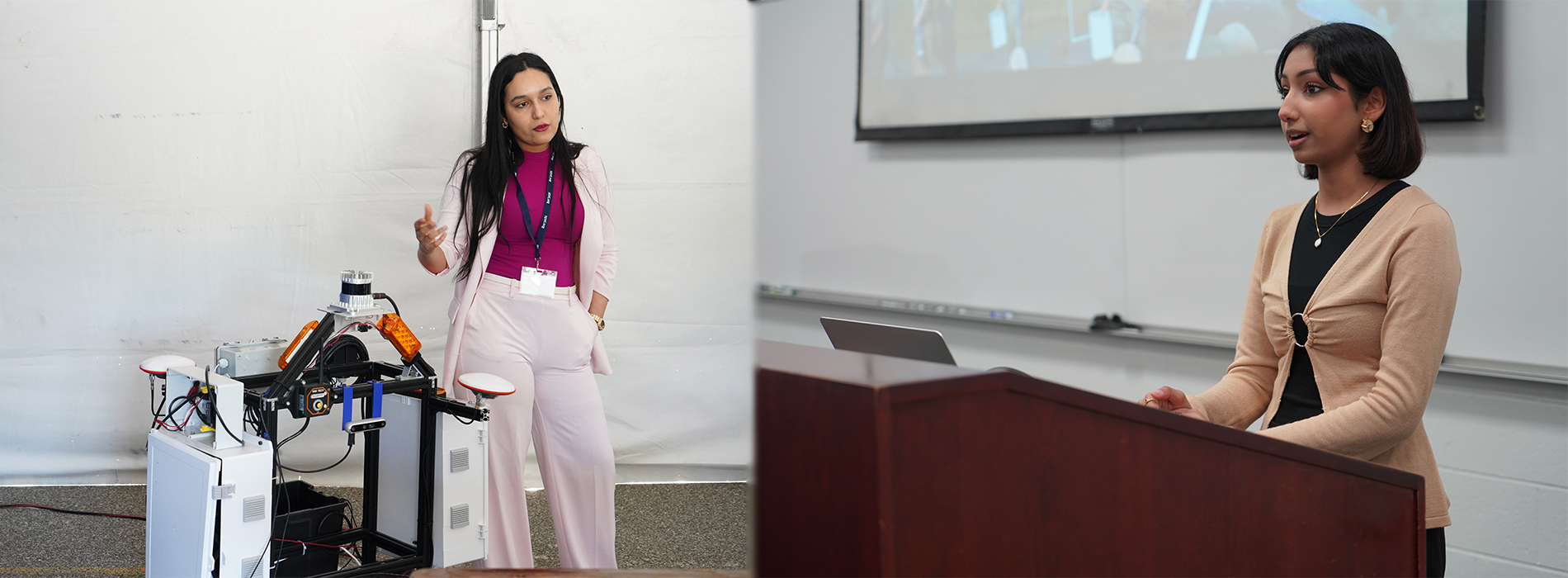
The first time Sam Abedi saw microplastics moving through fish tissue, it changed more than her understanding of the research.
It changed how she imagined her future.
Abedi, a University of Detroit Mercy Biology student, entered the University’s Summer Undergraduate Research Experience (SURE) program with plans to enroll in the 7-Year Dental Program.
As part of her research, she spent last summer exposing freshwater fish to microplastics to analyze the effects on their sense of smell.
“I was studying the fish for months, but when I finally put my results under a fluorescent microscope, everything clicked,” Abedi said.
By the end of the summer, she wanted to pursue research and drug development.
“It was a big jump, but something that I’m now really happy with,” Abedi said. “I feel like I saved myself a couple years down the line, realizing that maybe I wanted to pursue something else.”
Electrical Engineering student Amna Ben Abdelkader had a similar experience.
Before entering the SURE program, Ben Abdelkader expected a more traditional path through college: classes, internships, and eventually a conventional engineering job.
Then she saw a robot move.
“It was during the first project when I saw the robot moving and actually doing what it’s supposed to be doing,” Ben Abdelkader said. “I was like, ‘Yes, I did this.’”
Ben Abdelkader studied artificial intelligence and robotics for the first time during the SURE program. Step by step, using tools such as Python, YOLO and inverse kinematics, she learned how the two areas of study fit together and why research might be a better fit for her.
“Now I see myself in research and it’s completely different from what I expected.”
For both students, research opened doors to new career possibilities. But it also changed how they approached their education.
“Before SURE, I would not want to take on projects that would have fused multiple things together, but now I’d rather take on bigger problems,” Ben Abdelkader said.
That confidence has already translated into new experiences and opportunities that showcase her knowledge.
Ben Abdelkader has published two peer-reviewed Institute of Electrical and Electronics Engineers (IEEE) conference papers, was accepted into Detroit Mercy’s 5-Year Bachelor of Electrical Engineering to Master of Electrical and Computer Engineering program and is interested in pursuing a doctorate.
Abedi found a similar confidence through her work with faculty mentors.
Her freshwater fish research was conducted through a collaboration between the labs of Detroit Mercy’s Assistant Biology Professor Levi Storks and Biology Professor Rachelle Belanger.
Being trusted with meaningful responsibility changed how Abedi viewed her role in the lab.
“It was just a huge moment where I was taking charge of the project, and I had my own hand in it,” Abedi said.
That sense of ownership helped her see herself not just as a student, but as a researcher, she said.
She learned to analyze large data sets, conduct scientific writing and collaborate with other researchers. Those experiences led to a presentation at the Society for Integrative and Comparative Biology National Conference, a research opportunity this summer at NYU Grossman School of Medicine and now consideration of a Ph.D. in pharmacology.
For Katherine Snyder, dean of the College of Engineering & Science, this kind of discovery is one of the most valuable parts of undergraduate research.
“Research gives students the opportunity to move beyond learning what is known and build the critical thinking skills that are essential to solving complex problems in the workforce and in our communities,” Snyder said.
But students can’t discover opportunities they don’t know exist.
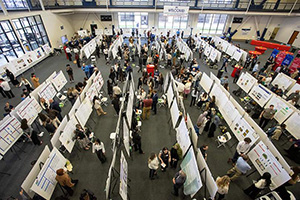 Detroit Mercy has a long history of commitment to undergraduate research which extends across programs and disciplines.
From 2014-25, the University participated in ReBUILDetroit, a National Institutes of Health-funded program supporting students from underrepresented and economically disadvantaged backgrounds pursuing careers in biomedical research.
Today, students can pursue research through SURE, faculty-mentored projects, course-based research experiences, and research symposiums.
SURE is the University’s latest offering, giving students a hands-on introduction to research.
Now in its second year, the program provides full-time undergraduate students in the College of Engineering & Science with the opportunity to gain sustained research experience while exploring research-focused or graduate level career paths.
Students can apply in early March. If accepted, the part-time role covers eight weeks between May and August, with each student receiving a $2,500 stipend.
The Office of Undergraduate Research in STEM + Graduate Opportunities (OURS+GO) serves as the hub for connecting Detroit Mercy students with opportunities like SURE as early as their first semester. The office helps students navigate steps that may be unfamiliar, things like approaching faculty mentors, developing a research résumé, and requesting letters of recommendation.
“We want to give students the chance to experience research, follow their curiosity and begin to see what might be possible for them,” said Sarah James, program coordinator for OURS+GO.
For many students, that opportunity begins with the guidance of a faculty mentor like Belanger.
Belanger has mentored undergraduate researchers for more than 16 years in her olfactory development and toxicology lab. She has taken students to national conferences to present their research, meet scientists in their fields and build professional networks.
She believes communicating research – through writing academic papers, creating research posters and delivering presentations – is an important part of helping students understand the significance of their work.
“The act of communicating research challenges students to think more deeply about their work and explain not only what they found in a clear and concise way, but why it matters,” she said.
Belanger’s commitment to undergraduate mentorship was recognized in June, when she received the Council on Undergraduate Research (CUR) 2026 Biology Mentor Award in the Mid-Career category. It was the second time CUR recognized her mentorship; she also received the organization’s Early-Career Biology Mentor Award in 2017.
But the most meaningful measure of mentorship, Belanger said, is watching students begin to recognize their own value.
“I love seeing a student go from wondering whether they belong in a research lab to recognizing that they have something valuable to contribute,” Belanger said. “That transformation in confidence is just as important as the research itself.”
For Abedi and Ben Abdelkader, that transformation began with two simple moments: looking through a microscope and watching a robot move.
Abedi learned that she liked the challenge of research.
“When things don’t work out, I like trying to figure them out instead of finding a new route,” she said.
Ben Abdelkader discovered she had more perseverance than she thought.
“I was surprised by myself, because I didn’t believe that I was this ambitious or patient,” she said.
For more information about research opportunities, visit OURS+GO and https://eng-sci.udmercy.edu/research.
— By Phylisha Drayton. Follow Detroit Mercy on Facebook, LinkedIn, X and Instagram. Have a story idea? Let us know by submitting your idea.