

Psych students say class assignment is the G.O.A.T.
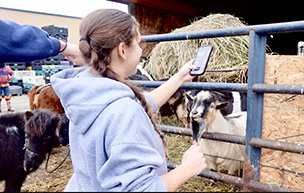 When most people think of a college-level psychology class, they picture long lectures, a heavy reading load and dense theories. But students at University of Detroit Mercy are learning those same psychological principles by training goats — yes, the actual animal.
This immersive approach to learning is the reality for students taking Associate Professor of Psychology Preston Foerder’s PYC 3150 Learning and Behavior Laboratory class.
“We are working with goats here in Detroit. It is the most random thing, but I love it,” said Psychology major and senior Brooklyn Zuziak, whose assigned goat’s name is LeBron.
The learning lab is the second part of a two-course series. Before advancing to the lab, students must take PYC 3140 Learning and Behavior.
The first course serves as a foundation and happens during the fall semester. It is lecture-based and structured like a typical class, with longer lectures, written tests, extensive reading and discussions of complex psychological theories. Students focus on the fundamental ways people learn, studying theories such as classical conditioning and operant conditioning through a textbook approach.
Operant conditioning is learning through consequences, where voluntary behaviors are shaped by rewards or punishments. Classical conditioning involves associations between stimuli that influence behavior.
“I am a very hands-on learner, and with lectures, no matter what it is, I can 100% love it and still sometimes struggle with the lecture,” Zuziak said. “So, this is a great switch. I love that this is not a normal class. Telling people, 'I work with goats' is cool.”
 Foerder, who has a background in comparative psychology, the study of behavior across species, said students apply theories from the first course during the learning lab.
“They are seeing how the material that we study in the first half of the semester actually works on real animals, including human beings,” Foerder said. “The same principles we use in terms of learning and teaching animals also work on humans.”
Working with animals is not new in the field of psychology, but using goats is unusual. Foerder said he wanted to try something different and was inspired after seeing Pingree Farms featured on the local news.
“Normally in a class like this you would use mice or rats. I’ve even had colleagues who have used dogs,” Foerder said. “But when I found out about Pingree Farms, I wanted the students to come here.”
Now, every Friday at 3 p.m., students pack their bags, leave the classroom and drive, often carpooling about nine minutes from the University’s campus to the farm on Detroit’s east side.
The farm sits in a secluded urban-industrial neighborhood on East Seven Mile Road and Omira. From the outside, it resembles a warehouse, but the building is brightly painted with animals, fruits and vegetables, bringing a pop of color to the area. The farm has pigs, cows, sheep, horses, and, of course, goats.
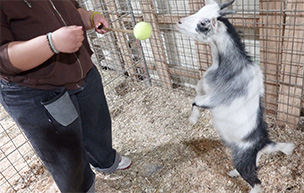
“Students start off training them with clicker training,” Foerder said. “You click and then feed them. The goats learn that when they hear the click, they have done something right.”
Students then move on to target training, where goats learn to touch a ball attached to a stick and follow it, which helps the students guide them through more complex behaviors.
Students work in groups of two or three, with each group assigned a specific goat. One student works directly with the goat inside an enclosure while the others observe. After about 30 minutes, they switch roles.
Students say one of their favorite parts of the class is watching the goats learn and improve over time.
“We have had days where LeBron is not listening, and he’s being challenging and difficult,” Zuziak said. “Then the next week he’s on top of everything, so it’s really rewarding to see how what we are doing actually works.”
Foerder said the class quickly became something students look forward to.
“They’ve told me this is the one thing they are looking forward to all week, coming to work with their goats,” Foerder said. “They can see the effect that they are having.”
Foerder said the training principles used with goats also apply to human behavior. The concepts students practice are foundational to applied behavior analysis, the primary therapy used for children with autism.
That connection is something students say they plan to carry into their careers.
“I can apply this very easily in the real world because I want to work with children,” said Gracelyn Peebles, a senior majoring in Criminal Justice and Psychology. “There are elements that are similar between animals and children, especially communication through body language and sounds.”
Peebles said the experience is helping her build patience and practical skills.
“I am learning to have patience with animals, which then transfers over to kids, and it all comes together,” she said.
The class also exposes students to parts of Detroit they may not have otherwise discovered.
“I never thought I would be holding a goat at 22 years old,” Peebles said. “It shows us that you don’t have to be in very privileged areas to experience these cool things.”
For their final project, students will train their goats to perform three routine behaviors in a row.
Watch a video of the students working with their goats

— By Sierra Searcy. Follow Detroit Mercy on Facebook, LinkedIn, X and Instagram. Have a story idea? Let us know by submitting your idea.